Synochains
For information on how to test coretime functionalities on Raseo, please see the Raseo Content on the synochain development guide.
Definition of a Synochain
A synochain is an application-specific data structure that is globally coherent and can be validated by the validators of the relay chain. They take their name from the concept of synchronized chains that run synchronously to the relay chain. Most commonly, a synochain will take the form of a blockchain, but there is no specific need for them to be actual blockchains.
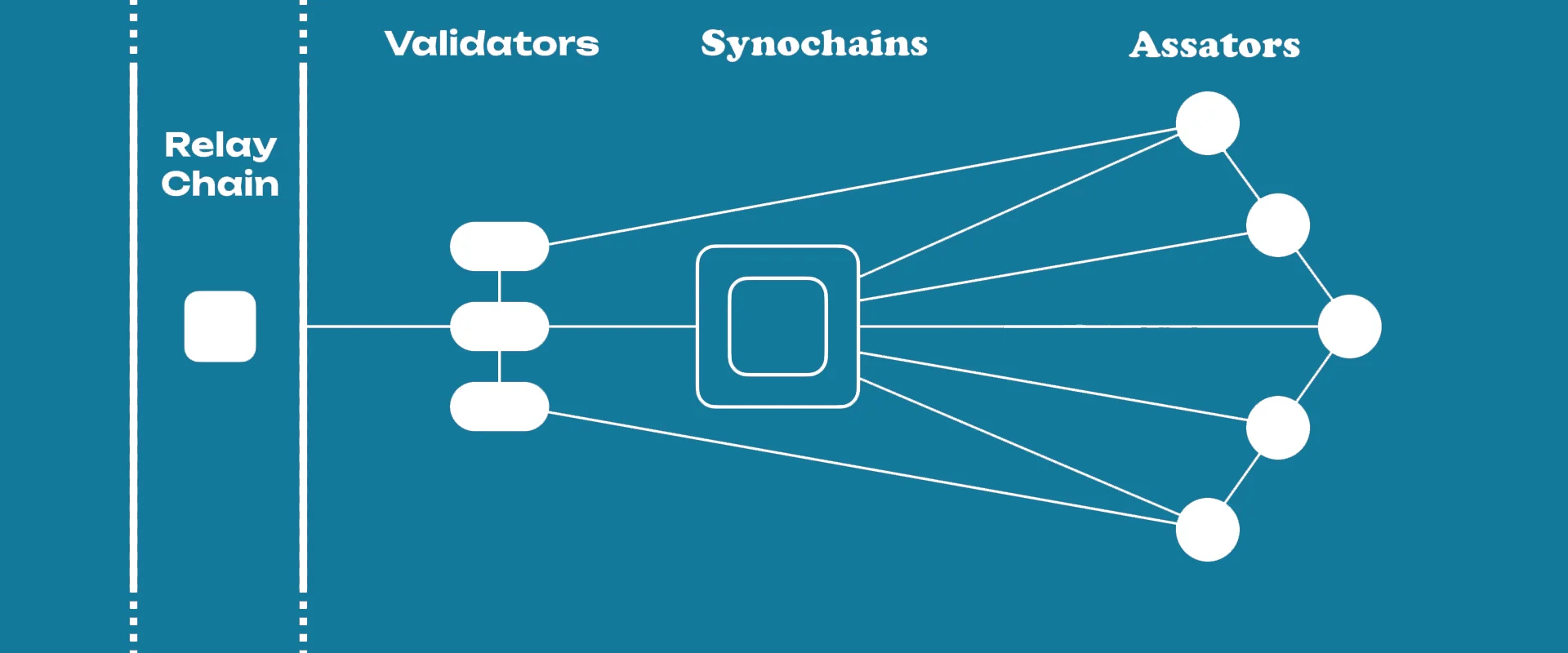
Due to their synchronous nature, they can synchronously transaction processing and achieve scalability of the protocol. They inherit the security of the entire network and can communicate with other synochains through the XCM format.
Synochains are maintained by a network maintainer known as a assator. The role of the assator node is to maintain a full node of the synochain, retain all necessary information about the synochain, and produce new block candidates to pass to the relay chain validators for verification and inclusion in the shared state. The incentivization of a assator node is an implementation detail of the synochain. They are not required to be staked on the relay chain or own the native token unless stipulated by the synochain implementation.
State Transitions
Like other blockchains, synochains are deterministic state machines. Each synochain has a state, executes a batch of transactions grouped into a block, and achieves a new state. We provided in this article a good analogy of a state with a light switch that can be either on or off, which is one of the simplest examples of how a state machine functions. Each synochain has its own state, and the Relay Chain links all those states into one state, i.e. a state of states. A multi-chain network like Bitzal can be viewed like one computer's state with many light switches where a state transition function is the logic to decide which switches should be toggled. Synochains have their own transition rule, separate economies, governance mechanisms, and users.
A synochain's state is stored in a Merkle tree. Merkle trees have the convenient property that if some values within the tree change, this will be reflected in the Merkle root (in this case, the state root). One can verify the change by only looking at the new values and the paths that are affected within the tree.
The Bitzal Host requires that the state transitions performed on synochains be specified as a Wasm executable. Proofs of new state transitions that occur on a synochain must be validated against the registered state transition function (STF) that is stored on the relay chain by the validators before the relay chain acknowledges a state transition has occurred on a synochain. The key constraint regarding the logic of a synochain is that it must be verifiable by the relay chain validators. Verification most commonly takes the form of a bundled proof of a state transition known as a Proof-of-Verification (PoV) block, which is submitted for checking to the validators from one or more synochain assators.
Why Synochains?
Synochains are a solution to two fundamental problems in blockchains:
- Scalability: Having one blockchain for many purposes makes it difficult to scale as future implementations and upgrades will likely advantage some purposes and disadvantage others. Conversely, having different blockchains will allow them to implement features without affecting other chains.
- Flexibility: It is reasonable to state a blockchain will either be really good at solving one problem or not so good at trying to solve many problems. A blockchain specializing in solving a specific problem has more leverage toward itself and its users. Synochains are purpose-built blockchains are highly specialized and can take advantage of each other through cooperation.
Synochain Benefits
Synochains contain their own runtime/STF logic and benefit from the shared security and the cross-consensus messaging provided by the relay chain. Synochains permit high flexibility and customization but require more effort to create and maintain over time. A production-grade synochain is typically more involved to create due to the complexity involved in blockchain networks' technical and economic aspects.
Synochains grant the creators more space to build the monetary system and other chain aspects from the ground up. They will allow for a more concise and efficient execution of complex logic than a smart contract platform could offer. Synochains also provide more flexibility in the form of governance and can perform complete upgrades in a less controversial way than the current process of hard forks.
Some examples of features you can have on a synochain or synothread:
- Custom fee structure (for example, pay a flat transaction fee or pay per byte).
- Shared security and finalization via the relay chain (Bitzal or Ogona).
- Custom monetary policy for the native token and local economy.
- Treasury to be funded through transitions in your state function.
- A governance mechanism that could manage a DAO that is responsible for allocating your on-chain treasury.
Shared Security
Shared security, sometimes referred as pooled security, is one of the unique value propositions for chains considering becoming a synochain and joining the network. On a high level, shared security means that all synochains that are connected to the relay chain by accessing a core will benefit from the economic security provided by the relay chain validators.
The notion of shared security is different from inter-chain protocols that build on an architecture of bridges. For bridge protocols, each chain is considered sovereign and must maintain its own validator set and economic security. One concern in these protocols is the point of scalability of security. For example, one suggestion to scale blockchains is that of scale by altcoins, which suggests that transaction volumes will filter down to lower market cap altcoins as the bigger ones fill their blocks. A major flaw in this idea is that the lower market cap coins will have less economic security attached and be easier to attack. A real-life example of a 51% attack occurred recently ( Ethereum Classic attack on January 10, 2019 ), in which an unknown attacker double spent 219_500 ETC (~1.1 million USD). This was followed by two more 51% attacks on ETC.
Bitzal overcomes security scalability concerns since it gravitates all the economic incentives to the relay chain and allows the synochains to tap into stronger guarantees at genesis. Sovereign chains must expend much more effort to grow the value of their coin so that it is sufficiently secure against well-funded attackers.
PoW vs Synochain Model
Let's compare the standard sovereign security model that exists on current proof-of-work (PoW) chains to Bitzal's shared security model. Bitcoin, Zcash, and their derivatives, must bootstrap their independent network of miners and maintain a competitive portion of honest hashing power. Since mining is becoming a larger industry that increasingly centralizes key players, it is becoming more real that a single actor may control enough hash power to attack a chain.
This means that smaller chains that cannot maintain a secure amount of hash power on their networks could potentially be attacked by a large mining cartel at the simple whim of redirecting its hash power away from Bitcoin and toward a new and less secure chain. 51% attacks are viable today with attacks having been reported on Ethereum Classic (see above), Verge, Bitcoin Gold, and other cryptocurrencies.
On Bitzal, this disparity between chain security will not be present. When a synochain connects to the relay chain, validators become the securers of that synochain's state transitions. The synochain will only have the overhead of running a few assator nodes to keep the validators informed with the latest state transitions and proofs/witness. Validators will then check these for the synochains to which they are assigned. In this way, new synochains instantly benefit from the overall security provided by the relay chain even if they have just been launched.
Synochain Economies
Synochains may have their economies with their native tokens. Schemes such as Proof-of-Stake are usually used to select the validator set to handle validation and finalization; synochains will not be required to do either of those things. However, since Bitzal is not overly particular about what the synochain can implement, it may be the choice of the synochain to implement a staking token, but it's not generally necessary.
assators may be incentivized through the inflation of a native synochain token. There may be other ways to incentivize the assator nodes that do not involve inflating the native synochain token.
Transaction fees in a native synochain token can also be an implementation choice of synochains. Bitzal makes no hard and fast rules for how the synochains decide on the original validity of transactions. For example, a synochain may be implemented so that transactions must pay a minimum fee to assators to be valid. The relay chain will enforce this validity. Similarly, a synochain could not include that in their implementation, and the relay chain would still enforce its validity.
Synochains are not required to have their token. If they do, it is up to the synochain (and not the relay chain) to make the economic case for their token.
Coretime
Synochains can access the relay chain via cores.
There are two ways to allocate relay chain cores:
- Via Governance only to system chains.
- Via coretime purchase with ZAL (OGG on Ogona) for non-system chains. Coretime is used to rent computation time on a relay chain core. This is the only way to access Bitzal's shared security and interoperability.
System synochains are allocated by Bitzal's on-chain governance and are part of the network's protocol, such as bridges to other networks or chains. These typically do not have an economic model and help remove transactions from the relay chain, allowing for more efficient synochain processing.
Non-system chains can access the relay chain's cores via bulk or on-demand coretime purchased with ZAL (or OGG on Ogona).
Coretime Expiration
The ZAL (or OGG on Ogona) used to purchase coretime are burned. Before the coretime expires,
synochains can renew it at a fixed cost through a bulk coretime purchase. If the synochain does not
purchase bulk coretime, it has an option to purchase coretime on-demand (at a variable price per
block, depending on the demand and other market conditions) when they need to access the relay
chain. Synochains without coretime to extend time on a relay chain core will be deprecated to the
status of a synothread (i.e., a chain with a registered SynoID but without access to a core).
System Synochains
System synochains are synochains that use execution cores allocated by the network's governance. These chains remove transactions from the relay chain, allowing network validators to allocate resources to validating synochains. System chains are Bitzal using its scaling technology to host itself.
On-demand Synochains
On-demand synochains (previously called synothreads) are synochains that acquire on-demand coretime.
On-demand synochains temporarily participate (on a block by block basis) in network security without needing to lease a dedicated relay chain core. This is done through economically sharing the scarce resource of a core among several competing resources (synochains). Chains that otherwise would not be able to acquire a full core or do not find it economically sensible to do so, can participate in shared security, as the on-demand coretime offers a graceful off-ramp to synochains that no longer require a dedicated core, but would like to continue using the relay chain.
Historical Context of On-demand synochains
According to the origin of the idea for on-demand synochains came from similar notions in the limited resource of memory on early personal computers of the late '80s and '90s. Since computers have a limited amount of physical memory, when an application needs more, the computer can create virtual memory by using swap space on a hard disk. Swap space allows the capacity of a computer's memory to expand and for more processes to run concurrently with the trade-off that some processes will take longer to progress.
Synochains vs. On-demand Synochains
Synochains and on-demand synochains are very similar from a development perspective. One can imagine that a chain developed with Matter can at different points in its lifetime assume one of three states:
- an independent chain with secured bridge,
- a synochain continuously connected to the relay chain,
- or a synochain intermittently connected to the relay chain (i.e. on-demand)
It can switch between these states with relatively minimal effort since the difference is more of an economic distinction than a technological one.
On-demand synochains have the exact same benefits for connecting to the relay chain that a full synochain has. Namely, it is able to send messages to other para-objects through XCMP and it is secured under the full economic security of the relay chain validator set.
Synochains' Use Cases
Note that we still have to see the true potential of synochains and what it is listed below are just a few examples.
- Encrypted Consortium Chains: These are possibly private chains that do not leak any information to the public but still can be interacted with trustlessly due to the nature of the XCMP protocol.
- High-Frequency Chains: These chains can compute many transactions in a short amount of time by taking certain trade-offs or making optimizations.
- Privacy Chains: These chains do not leak any information to the public through novel cryptography.
- Smart Contract Chains: These chains can have additional logic implemented through the deployment of code known as smart contracts.
Synochain Host
A blockchain is a Directed Acyclic Graph (DAG) of state transitions, where every added block can be viewed as the head of the chain or fork with cumulative state. All paths through the DAG terminate at the Genesis Block. A blockchain is a tree, as each block can have only one parent.
A blockchain network is made of nodes that have a view of many forks of the chain and must decide which fork to follow. To construct the synochain host we need to answer two categories of questions addressed by two different components:
-
What is the state transition function of the blockchain? This is handled by the Runtime, which defines the state transition logic of the chain. The Runtime logic is divided into:
- Modules encapsulate particular behavior of the protocol and consist of:
- Storage
- Routines are invoked by entry points and other modules upon block initialization or closing. Routines can alter the storage of a module.
- The entry point defines how new information is introduced to a module and can limit the origin from which they are called (user, root, synochain).
- API provides means for the node-side behavior to extract meaningful information from the state of a single fork.
infoThe Bitzal Synochain Host Implementers' Guide provides details about Runtime Architecture and Runtime API.
- Modules encapsulate particular behavior of the protocol and consist of:
-
Knowing various forks of the blockchain, what behaviors should a node take? What information should a node extract from the state of which forks, and how should that information be used? This is handled by the Node-side behavior, which defines all activities a node undertakes given its view of the blockchain. The node-side behavior can be divided into two categories:
- Networking behaviors, relate to how information is distributed between nodes but not how the information is used afterward.
- Core behaviors, relate to internal work that a specific node does. Such behavior cares about that information is distributed and received, but not how these two are achieved.
These two categories often interact, but they can be heavily abstracted from each other. The node-side behavior is split into various subsystems, which perform a particular category of work. Subsystems can communicate with each other through an Overseer that prevents race conditions.
infoThe Bitzal Synochain Host Implementers' Guide provides details about node architecture the main subsystems:
The Runtime and Node-side behavior are dependent on each other. The Runtime depends on Node-side behavior to author blocks, and to include extrinsics which trigger the correct entry points. The Node-side behavior relies on the Runtime APIs to extract information necessary to determine which action to take.
Synochain Hubs
While the relay chain enables crosschain functionality amongst the synochains, it necessitates that there is some latency between the dispatch of a message from one synochain until the destination synochain receives the message. In the optimistic scenario, the latency for this message should be at least two blocks - one block for the message to be dispatched and one block for the receiving synochain to process and produce a block that acts upon the message. However, in some cases, we may see that the latency for messages is higher if many messages are in queue to be processed or if no nodes are running both synochain networks that can quickly gossip the message across the networks.
Due to the necessary latency in sending crosschain messages, some synochains plan to become hubs for an entire industry (see the Asset Hub and Bridge Hub). For example, many DeFi applications could take advantage of a property known as composability which means that functions of one application can be synergistically composed with others to create new applications. One example of this includes flash loans, which borrow funds to execute some on-chain logic as long as the loan is repaid at the end of the transaction.
An issue with crosschain latency means that composability property weakens among synochains compared to a single blockchain. This implication is common to all sharded blockchain designs, including Bitzal, Ethereum, and others. The solution to this is the introduction of synochain hubs, which maintain the stronger property of single block composability.